The AI pilot stalled. Or it shipped, but nobody uses it. Maybe it generated numbers that sit on a dashboard nobody trusts, next to the spreadsheet the team actually opens every Monday.
This is the conversation we have most often with operators running AI initiatives right now. A pilot got funded, a model got tuned, a tool got deployed, and somewhere between launch and adoption, the work stopped translating into business value. Leadership wants to know whether the AI pilot was the wrong call. Usually it wasn’t.
What the numbers (and experts) are saying
I spent a day in May at MinneAnalytics Data Tech 2026, in rooms with PhDs, data scientists, data engineers, and machine learning practitioners shipping real AI systems in large companies.

What I heard there echoes what we have been reading and what we see in our own client work. The pilots that stall are those whose organizations focus only on the foundation or only on momentum, but never on both at the same time.
The numbers are blunt. Gartner says 50% of generative AI projects were abandoned after the POC stage by the end of 2025. The reasons given are not new: vague scope, bad data, growing tech debt. AI just accelerates the failures that were already there.
The key to seeing ROI from your next AI pilot
Foundation and momentum in parallel is the pattern we’re seeing in successful pilots. Skip the foundation, and trust slips on the first dashboard nobody can verify. Build only the foundation, and the org loses faith long before the work has anything to show for itself.
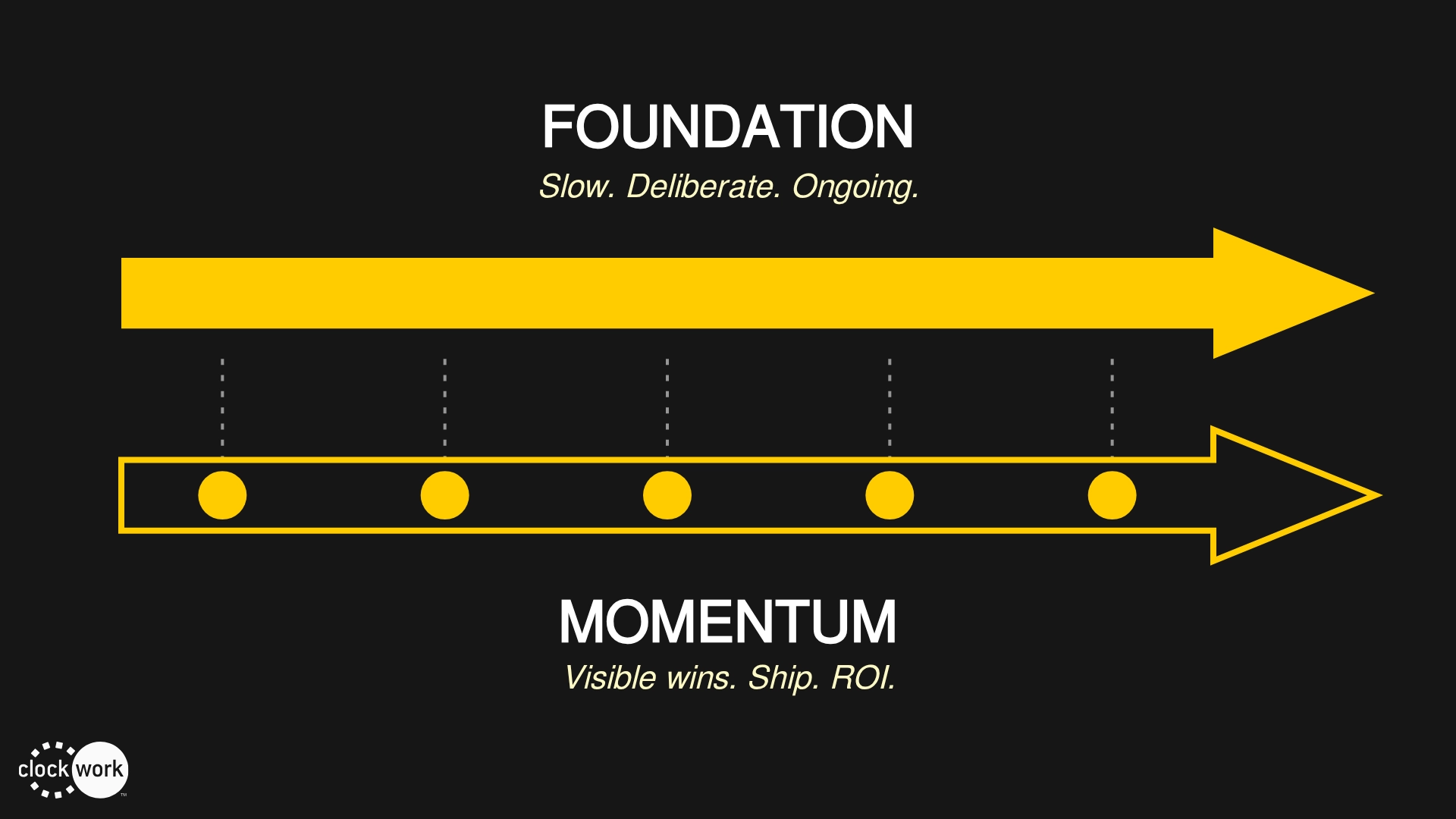
The companies whose AI work compounds are the ones running both tracks at once.
Foundation work has three parts, in this order: people, process, and technology.
- People means business ownership of the outcome, not IT-only governance, and change capacity built in from the start rather than bolted on at the end.
- Process means definitions everyone agrees on, data flow that matches how the work actually happens, and decisions made on the same numbers.
- Technology means a platform that analysts do not have to negotiate with, cloud-scale where it matters, and integrations that hold up under real use. None of these are new ideas. What is new is how visible their absence becomes the moment you try to run an AI pilot on top of them.
Momentum is what the rest of the organization sees.
Good, quick wins are concrete. A governed dataset delivered to a high-visibility team. A standard KPI replacing four conflicting versions. A self-service dashboard that used to take IT three weeks. A pilot team demonstrating the new operating model in practice. None of these are splashy. They are deliverables the business can point at and say yes, that is value, and yes, it sits on the foundation rather than around it.
The test that ties the two tracks together.
Foundation work should produce visible wins, and every visible win should sit on the foundation. If your foundation work is not producing visible wins, the org will stop funding it. If your visible wins are not actually built on the foundation, you are accumulating debt under the AI pilot rather than paying it down.
5 questions to ask before an AI project
Before any AI engagement, we run a short readiness check. Ask these five questions:
- Can the people doing the work name the outcome that this pilot is supposed to change?
- Does the process this pilot depends on run the same way today as it did six weeks ago?
- Is the data showing up in the systems where the work actually happens, not in a parallel one? Would your team make a decision off this data today, before AI is involved?
- Does one person on the business side own whether this works, not just whether it ships?
If any answer is no, start there.
3 moves to make the next AI pilot ship
- First, pick one foundation gap from the three parts above and start that work this quarter, with a named business owner.
- Second, pick one quick win that will sit on that foundation and ship it in 90 days.
- Third, run them together, and use the five-question check to know when the next pilot is ready to fund.
Build for adoption, not just launch. The pilots that compound are the ones whose organizations are doing the unglamorous work on both tracks simultaneously.
If this sounds like your situation, reach out. We’d be glad to think it through with you.