Growing through acquisition is a strategy. Integrating through acquisition is a different one.
Eighteen months after closing a deal, the gap between those two strategies shows up. Not as a crisis, but as a slow softening. Win rates that don’t quite hit the model. Customer relationships that feel fussier than they used to. Campaigns that drag because the data lives in different systems with different naming conventions. Nobody designed it that way. But almost everyone experiences it.
The acquisition cliff
This is the 18-month acquisition cliff. It shows up across industries — financial services, manufacturing, healthcare, professional services, technology, distribution — anywhere that growth-through-acquisition is the strategy.
Take this common scenario: a customer who regularly buys from three of your brands goes to place an order. They visit three different websites, call two different support lines, and find that the pricing they see online does not match what their account rep quoted.
What should be a routine transaction turns into a frustrating exercise in figuring out who actually has the right answer.
What hinders post-acquisition integration?
The cliff is not caused by bad leadership, but by a mismatch between two clocks.
The organizational clock moves fast. A consolidation can be announced in a week, structured in a month, and staffed in a quarter. The org chart reflects the new reality almost immediately.
The systems clock moves at the pace of technology decisions, integration work, and the institutional knowledge required to connect platforms that were never designed to talk to each other. Two legacy CRMs from two separate companies are not going to reconcile themselves. Neither are two billing systems, two customer portals, or two sets of product taxonomy built by teams who never knew the other existed.
Companies that navigate this period well treat the months following a consolidation as a data architecture window. The goal is not an immediate platform replacement or a wholesale technology overhaul. Instead, the focus is on building enough clarity around systems, dependencies, and data ownership to make the next round of decisions with confidence.
Start from the outside in
To approach this differently with clients, we begin with a diagnostic that starts from the outside in. Before mapping systems, we map the customer. Where does a buyer, a partner, or a channel touch your data? That is where integration failures become customer experience failures.
From there, three questions drive the work.
- What data needs to look the same across the organization to protect the customer relationship and the margin? Not all data. Just the data a customer, a partner, or a channel actually touches.
- Which systems need to talk to each other, and in what sequence? Every integration creates dependencies. Getting the order wrong means redoing the work.
- What can stay different because it legitimately serves a different market or segment? Not every business unit needs to operate identically. Unifying everything is not the goal. Unifying what needs to be unified is.
Those three questions, answered in the right order, prevent most of the downstream reconciliation work that quietly eats margin in year two.
There’s one pattern that tends to stay invisible until it gets expensive: the acquired company that came with its own partner or reseller network. If the deal brought you a group of independent operators producing or distributing under your brand, you are now running a communications and logistics operation on infrastructure built for a standalone company. Every new partner added to that network adds load to systems that were not designed for it. In that case, the cliff is not 18 months away. It may already be here.
The window is still open
It is possible to see the 18-month window as a decision point rather than a crisis. The companies that use it well come out with a unified data foundation and a customer experience that compounds over time. The ones that wait spend the following years reconciling what the org chart already resolved.
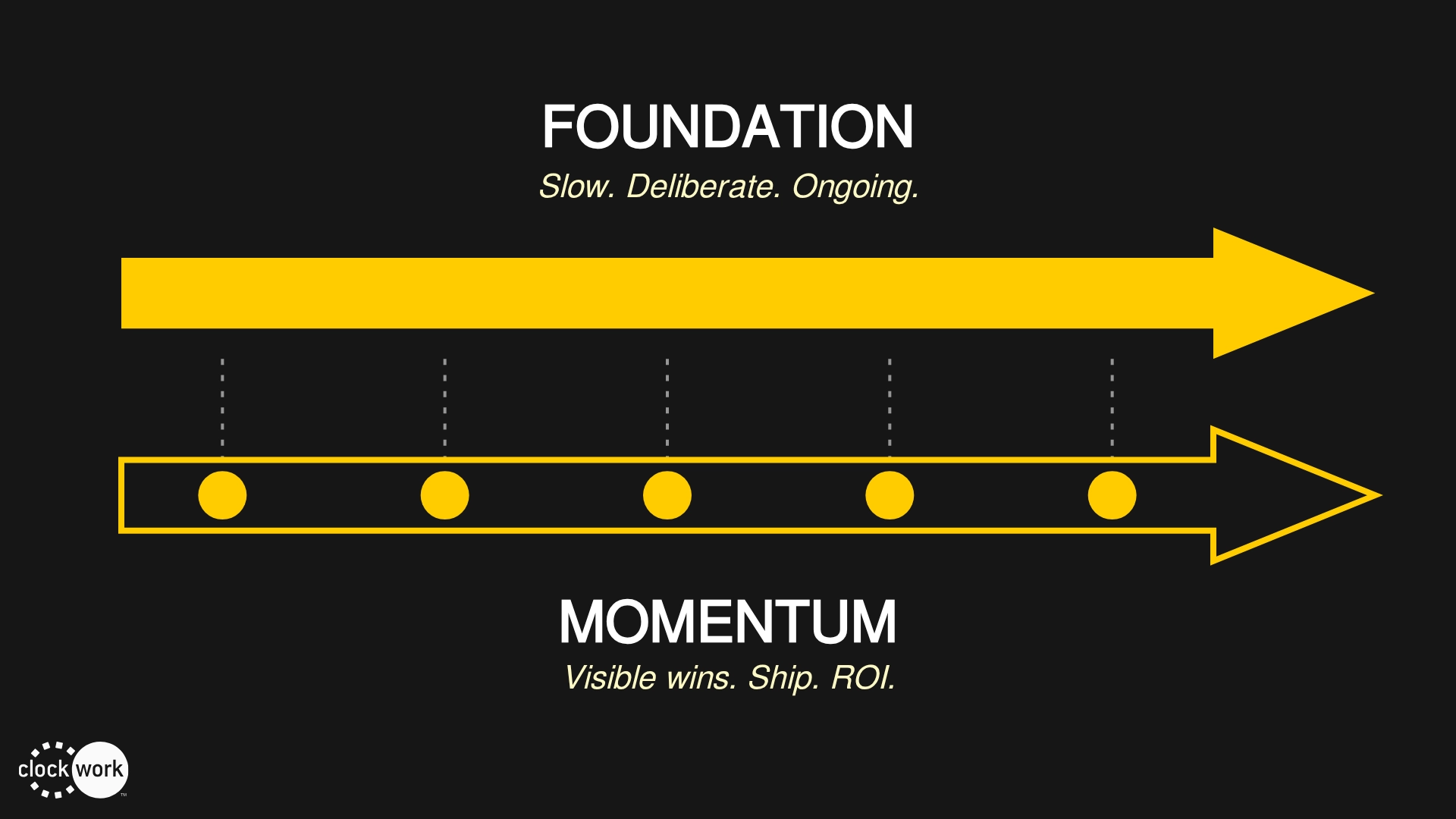
A successful integration strategy following an acquisition is not necessarily about integrating quickly, but rather, gaining clarity quickly. Before systems are replaced, data should be understood. Before platforms are selected, dependencies should be mapped. Taking inventory comes first. And it is almost always faster and cheaper than the repair.
The real return extends beyond cleaner data and clarity. This integration approach leads to a tighter customer experience that gets better with every year the business operates as one company. That compounding does not show up on the day of the close. It shows up eighteen months later, and every year after that.
Whether you’re planning an acquisition or facing the aftermath of one, we can help you approach integration differently so neither your customers nor your margins feel the squeeze. Let’s talk.