Most people think of experience design as buttons, screens, or branding. But the real magic is bigger than that. It’s the intentional craft of shaping how people move through your business and how they feel while they’re doing it. When you design with people at the center, you don’t just get a smoother product. You get a smarter organization, a stronger brand, and customers who actually want to come back.
Experience design is often conflated with visual design or user experience. While it encompasses both of these skill sets, it can’t be reduced to just one of them.
The core meaning of experience design can be found in the name itself: It is an approach that centers on people’s experiences to drive the design and features of your products, processes, environments, and strategies. Experience design draws on users’ needs, feelings, contexts, and mindsets to design experiences that center on them.
Experience design covers a broad spectrum of interactions between businesses, their users, and their employees. These can range from everyday transactions like purchases or customer support to more specialized encounters such as new product launches, interactive displays or informational websites. Experience design is not limited to the customer experience, however. A core component of a good experience is how employees or those who are delivering the experience are supported and brought along. In this light, experience design also extends to how internal business tools like intranets, trainings, adoption programs and analytics dashboards are created and managed. All of these touch points offer businesses an opportunity to enhance the user experience for customers and employees.
Experience design is also a core component for your business strategy, enabling teams to innovate and new market opportunities. It provides a lens for practical and innovative problem-solving to address business and user challenges. Many disruptors, like Airbnb and Warby Parker, burst onto the market and found strong footing because they focused on user experience when developing their businesses.
For example, Lyft and other ride-sharing companies recognized that users didn’t want to wait for the driver to swipe a credit card, wonder if the driver would accept a card at all, or have to call to arrange a pick-up. So they focused on what customers did want: ease, convenience, and speed. They built an experience around those expectations, and it changed the industry.
Why is experience design important?
Designing an experience means more than making the life of your customer easy or delightful (which are common and vague “user-centered” goals), it means shaping the way the customer feels when they interact with your business. Easy isn’t great if it leaves the customer feeling insecure. For example, a form required only my name and email address (easy), but it didn’t reassure me that my information wouldn’t be sold (not great).
The bottom line is that no matter how much you prioritize designing a thoughtful experience (or not), your customers will have an experience with your service, product, or brand. Every app screen, web page, social media interaction, piece of software that is needed to take them from point A to point Z will elicit an emotion — what that emotion is, is mostly up to you.
Quality experience design means every single interaction is well considered, and all of it has to be coordinated and strategically implemented to be consistent. From the packaging to the mobile app, every touchpoint is an opportunity to convey the vision of your experience design.
If you practice Experience Design, you’re no longer focusing solely on the product, but on the experience as a whole. You’re literally selling an experience.
What to think about when it comes to designing experiences
To keep things simple, there are a few main components to keep in mind when understanding customer experience design.
Human-centered thinking is a requirement
Experiences require every detail and moment to be centered on the person. That means shifting your thinking from “what can we build?” to “what do people want to engage with?”
Knowing your users, listening to their needs, considering their contexts and environments — these are all ways to move experience to the center of your products.
Use data to make decisions
Great experiences are one part human-driven and one part data-driven. They are achieved qualitatively and quantitatively. Why? Because humans are pretty bad at knowing what they want.
Use data from customer feedback and analytics to assess where customers are engaging with your content or product. Successful experiences require that we adapt or iterate based on what we are learning and seeing from real-time user behavior. Data won’t tell you everything you need to know, but it will help you make decisions that create amazing experiences.
Data can sometimes be overwhelming, but AI and machine learning, paired with human review, can analyze vast amounts of behavioral data to identify patterns and plan for refined experiences. AI tools can also help you lean into personalized experiences, rather than designing a one-size-fits-all approach. Enabling dynamic personalization—adapting content, recommendations, and interfaces based on individual user behavior, preferences, and context allows your business to truly meet users where they are and deliver the experience they need, when they need it.
When you design experiences, not features, it affects your whole business
Centering on customers, rather than how your business is organized, will likely impact how your entire organization operates — and most notably, your internal culture. A recent Harvard Business Review article states, “the most common, and perhaps the greatest, barrier to customer centricity is the lack of a customer-centric organizational culture.”
Decisions that were once siloed will require a more holistic approach. What was once a marketing problem is reframed as a staff-wide problem because experiences are department-agnostic.
Modern digital strategy and design, along with users, is pushing us to consider the complete journey that customers are taking. In order to focus on journey-based experience, internal teams may need to change how they are working and collaborate more closely with cross-functional groups.
In the old model, the marketing department might have “increase orders” as an annual goal. But in the new model — one centered on experiences — the goal would be something like “shorten the time between an online order and the moment it arrives on a customer’s front porch” because they learned that lengthy ship time was the biggest customer pain point. That goal requires a much different organizational approach: The marketing team (who are in charge of increasing cart orders) must work collaboratively with fulfillment and operations (who are in charge of shipping time) to improve the customer experience.
Your technology choices matter
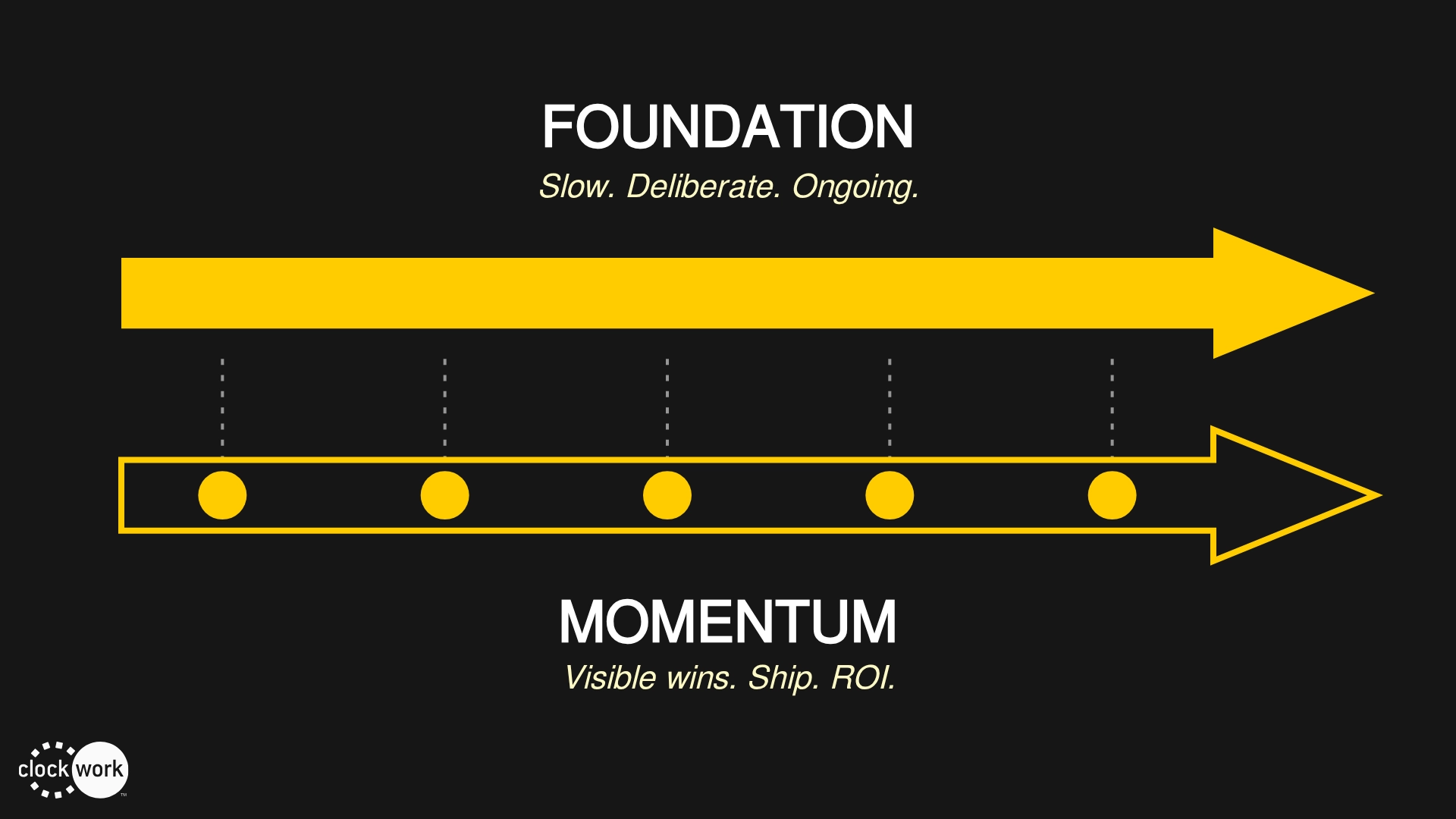
Designing a great experience is about more than what you — or your customers — can see. It might be easy to see how navigation menus, workflows, and search filters can impact your users’ experience, but the underlying foundation is just as important.
The technology that powers those menus and features is crucial to all aspects of what users experience.
- Will it be fast and efficient? If your technology is slow, users will use something else.
- Will it allow you to design and build the features and interactions you need in flexible ways? Your customers’ needs and wants can change quickly.
- Will you be able to gather the data you need to make user-centered decisions? Understanding your users is an ongoing project that requires tools.
The key takeaway is that experiences are driven by design and technology. When the two things aren’t in sync, you get experiences that are neither user-centered nor feature-centered. But when the two work together, it can turn customers into brand evangelists.
Create experiences for everyone
Whether you call it accessibility or inclusivity, one thing is certain: you should be designing for all customers. Not only does 20% of the population have some type of cognitive, physical, visual, or auditory disability, the rest of us are only temporarily abled. I could break a leg, have an accident, or lose some vision or hearing capabilities at any time. And I am definitely going to age and lose some abilities as that happens. Inclusively designed experiences are better for everyone. It’s universal.
Use experience design as a competitive advantage
Investing in the experiences you’re designing can improve your business. McKinsey & Company found a correlation between the McKinsey Design Index rankings and business performance. And, consumers are eager for more direct and meaningful interactions with brands. That all comes down to design and making experiences, not products or technology or features.
Let us help you develop a competitive advantage by building memorable experiences. Get in touch.